

Editorial text
When Ahmad was asked to approve sharing a child’s photo, he discovered that pausing can matter more than answering quickly.
Inspired by a true story. Some characters, situations, dialogue, and chronology have been reimagined or combined for narrative purposes.
Inspired by a true story. Some characters, situations, dialogue, and chronology have been reimagined or combined for narrative purposes.
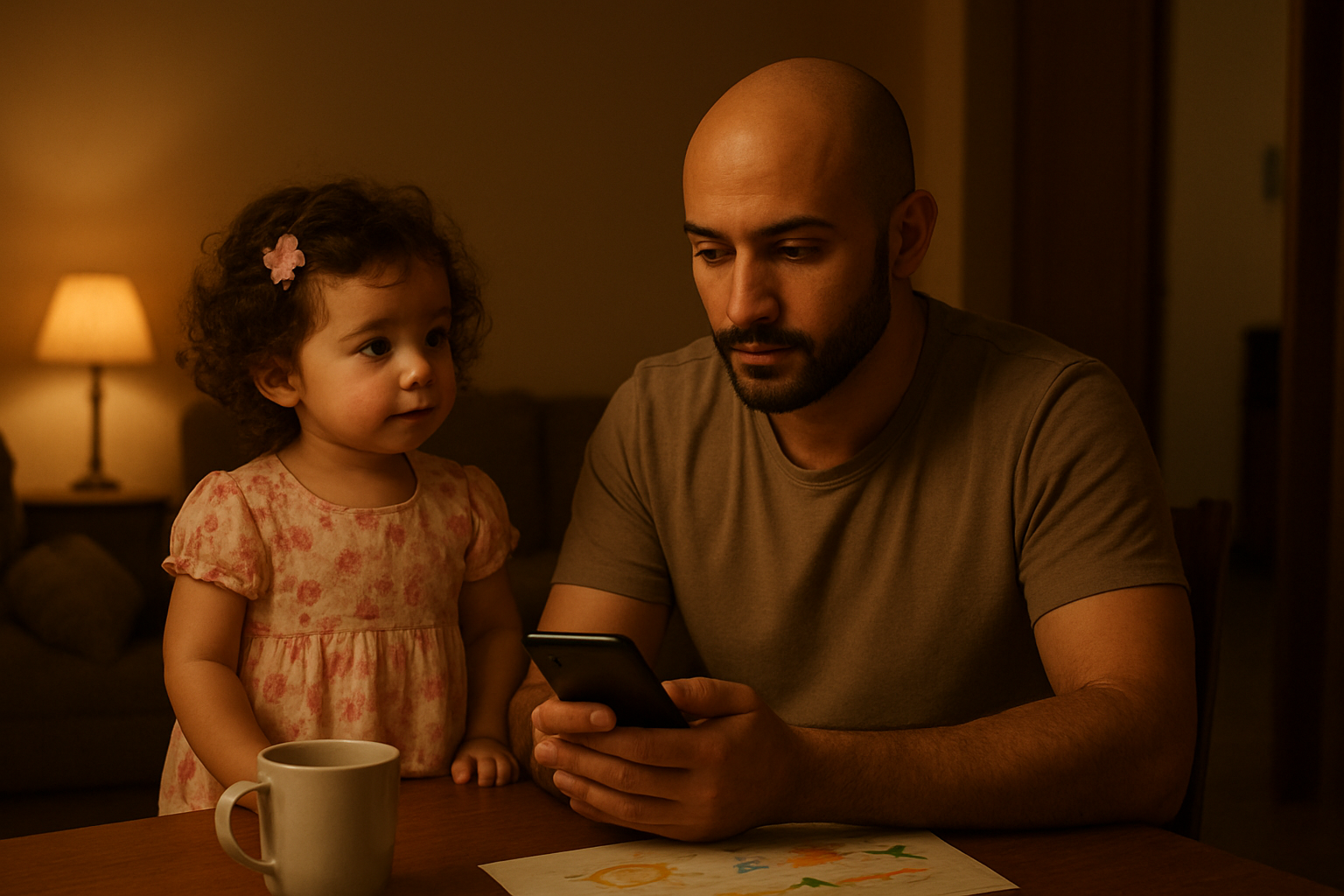
Evening was quiet in Ahmad’s home in Dammam, but his phone vibrated on the table as if someone had knocked insistently.
He had come back from a long day and left his keys by the door. A faint smell of tea lingered in the room.
Hala sat on the floor drawing with her colored pencils while Ahmad tried to give her his full attention before opening the phone.
She held the paper up to him. It showed a little house, a sun larger than the house, and shapes not yet settled into names.
Ahmad told her the sun was beautiful. Hala smiled and returned to her colors. Then the phone lit up again.
It was a voice message from an old friend, speaking in a hurried tone, as if a quick opinion could settle something he had put off all day.
Ahmad listened, then played the message again. His friend wanted to share a child’s photo on a public page for his friends.
His friend did not name the child, and Ahmad did not need to know. The question was not about anyone’s identity, but about what would be right to do.
His friend’s voice came through the phone again: “It’s an ordinary picture, and the family probably won’t mind. Should I post it?”
There was no ill intent in his friend’s voice. He wanted to share a pleasant moment, but the word “probably” carried a bigger decision than it seemed.
Ahmad looked at the colored drawing near his feet, then at the phone. It was not a child’s photograph, but it reminded him that small things can belong to the person who made them.
After a moment, he replied: “I don’t know whether sharing it is allowed in every situation. But don’t base the decision on them probably not minding.”
Ahmad sat at the edge of the table and moved his cup away from the drawing. He wanted to help without turning a guess into a ruling.
His friend asked, “So I should leave it? I don’t want to make a big deal of it, but I don’t want to embarrass anyone.”
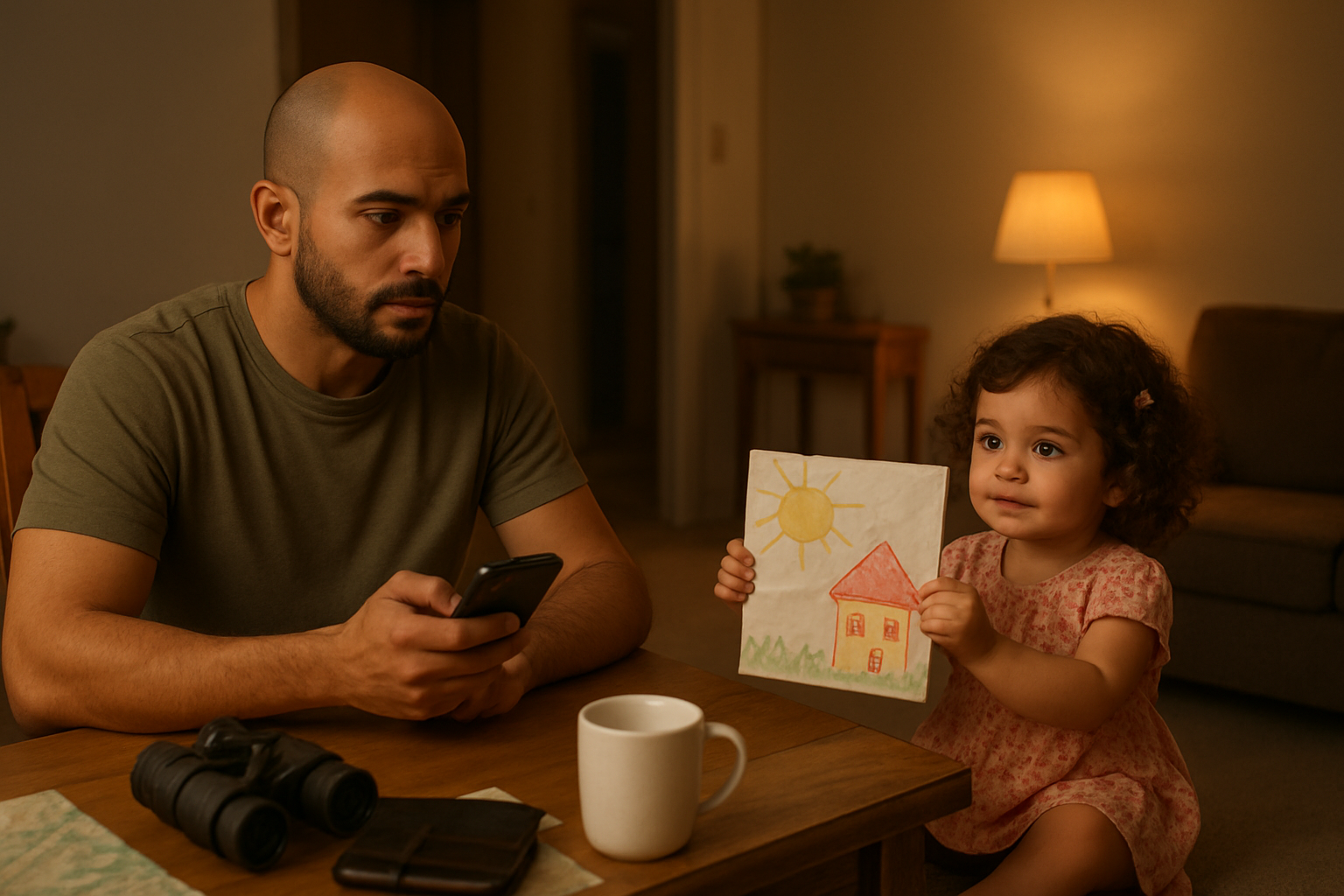
Ahmad said, “Give me a minute. I’ll check a general principle in an official source instead of answering from memory.”
His friend stayed on the line. A faint sound came from the other end, then silence. Ahmad opened an official United Nations page.
He read slowly. He was not looking for a sentence to reassure him or make him sound authoritative, but for a clear principle he could convey faithfully.
He found Article 16 of the Convention on the Rights of the Child. It protects children from arbitrary or unlawful interference with their privacy.
The article also refers to legal protection against unlawful attacks on a child’s honour or reputation. He reread it before summarizing it for his friend.
Ahmad said, “The principle is clear: a child has a right to privacy, and the law protects that right against unlawful interference.”
Then he added, “But this is a general provision. By itself, it isn’t enough to judge every photo, country, or circumstance.”
His friend breathed out slowly. “So you’re not telling me it’s forbidden?”
Ahmad said, “I can’t tell you that based on one general provision alone. I can say that a child’s privacy deserves a pause and careful thought.”
His eyes stayed on the page. A legal answer did not feel like a button one could press to turn a complicated situation into yes or no.
His friend asked, “Then what should I do now?”
Ahmad said, “Ask the child’s parent or guardian clearly before sharing. And remember, adults’ wishes aren’t the only thing that matters; the child’s privacy and dignity matter too.”
He did not present that as a detailed legal rule. It was cautious practical advice, alongside the acknowledgement that exact requirements depend on the law and circumstances.
His friend said, “I can wait. There’s nothing here worth rushing for.”
That simple sentence was clearer than a long debate. Ahmad had not asked him to fear every photo, only not to let the ease of sharing replace asking.
Hala’s pencil scratched across the paper. She drew a long yellow line, then paused to decide where to put it.
Ahmad told his friend, “Leave it until you’ve confirmed what the family wants and whether sharing it is appropriate. If you still have a specific legal question, ask a professional.”
His friend replied, “All right. I won’t post it tonight.” Then he thanked him without asking for a guarantee or a formal ruling.
The call ended. Ahmad held the phone for a moment, and the air conditioner’s hum filled the space left by the conversation.
He did not feel that he had solved a great problem. He had only slowed down an action that might have happened quickly and made room to ask the person it concerned.
Hala had lifted her drawing again. She was not waiting for an opinion about the law; she wanted Ahmad to notice the new color she had added to the sun.
He came closer and pointed to the purple near its edge. She said, “That’s for it.”
He did not ask her the name of the color or why she had chosen it. He simply smiled and returned the drawing to a place she could reach.
His phone was beside the drawing, its screen dark. He turned it face down and moved it a little away from the colors, so it would not crowd them.
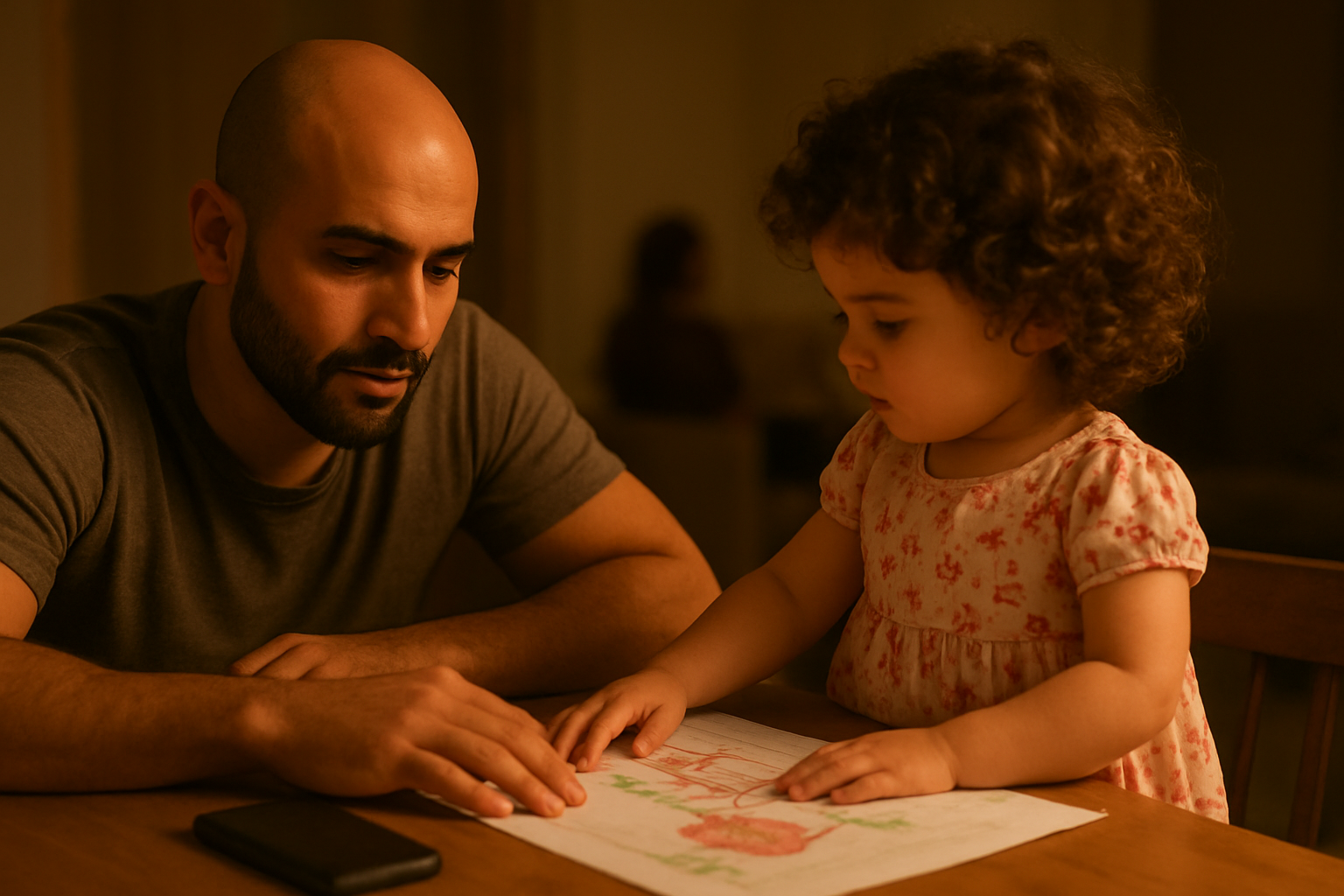
Hala’s small hand rested on the paper, and Ahmad’s hand stayed nearby without taking it or folding it. In the room, no one needed another explanation.
A few minutes later, Ahmad returned to the official page to confirm the article number and wording. He did not copy more than his friend needed.
He sent his friend the Convention’s name and the source link, adding that what he had shared was a general principle, not an assessment of a particular case.
Then he added a short message: “If the issue goes beyond whether to share the photo, get advice from a qualified professional in the relevant country.”
He did not write a long pronouncement, and he felt no need to sound like an expert. It was enough to know where his knowledge ended.
Hala offered him a pencil. He took the green one and made a small dot beside the house. She laughed, as if the dot had reached the place she was looking for.
Ahmad asked, “Here?”
She nodded, then returned to her drawing. The house was not neat, and it did not need to be.
Ahmad thought of the photo that had not been shared. He did not know how its story would end, but he knew that waiting had left the choice with the people it concerned.
It was not an answer to every question about privacy. It was one small step: do not assume permission, and do not speak with more certainty than you have.
Ahmad closed the page and left the phone on the table. That night, it was enough to leave the photo where it was.
The legal principle mentioned is based on Article 16 of the Convention on the Rights of the Child, published by the United Nations’ official source.
Not legal advice.
Official source: https://www.ohchr.org/en/instruments-mechanisms/instruments/convention-rights-child