

Editorial text
On the evening Ahmad nearly missed their game, Hala wasn’t asking him to win; she was waiting for him to sit down.
We use necessary cookies to run the site and keep your choices. The rest is optional, and it is your call. Privacy policy
Inspired by a true story. Some characters, situations, dialogue, and chronology have been reimagined or combined for narrative purposes.
Inspired by a true story; some characters, situations, dialogue, and chronology have been reimagined for narrative purposes.
When Ahmad entered the living room, the block bridge had collapsed for the second time. Hala was still kneeling on the rug, staring at the scattered pieces.
He was carrying a cup of tea, and his mind was full of things that hadn’t finished with the day. He set the cup by the table and looked at the bridge.
The room held a soft yellow light, and the smell of a warm dinner still lingered in the air. On the rug, the family’s weekly game was waiting to begin.
His wife sat near Hala, watching the pieces and leaving her room to decide what to build. She wore simple home clothes, her wavy hair falling around her face.
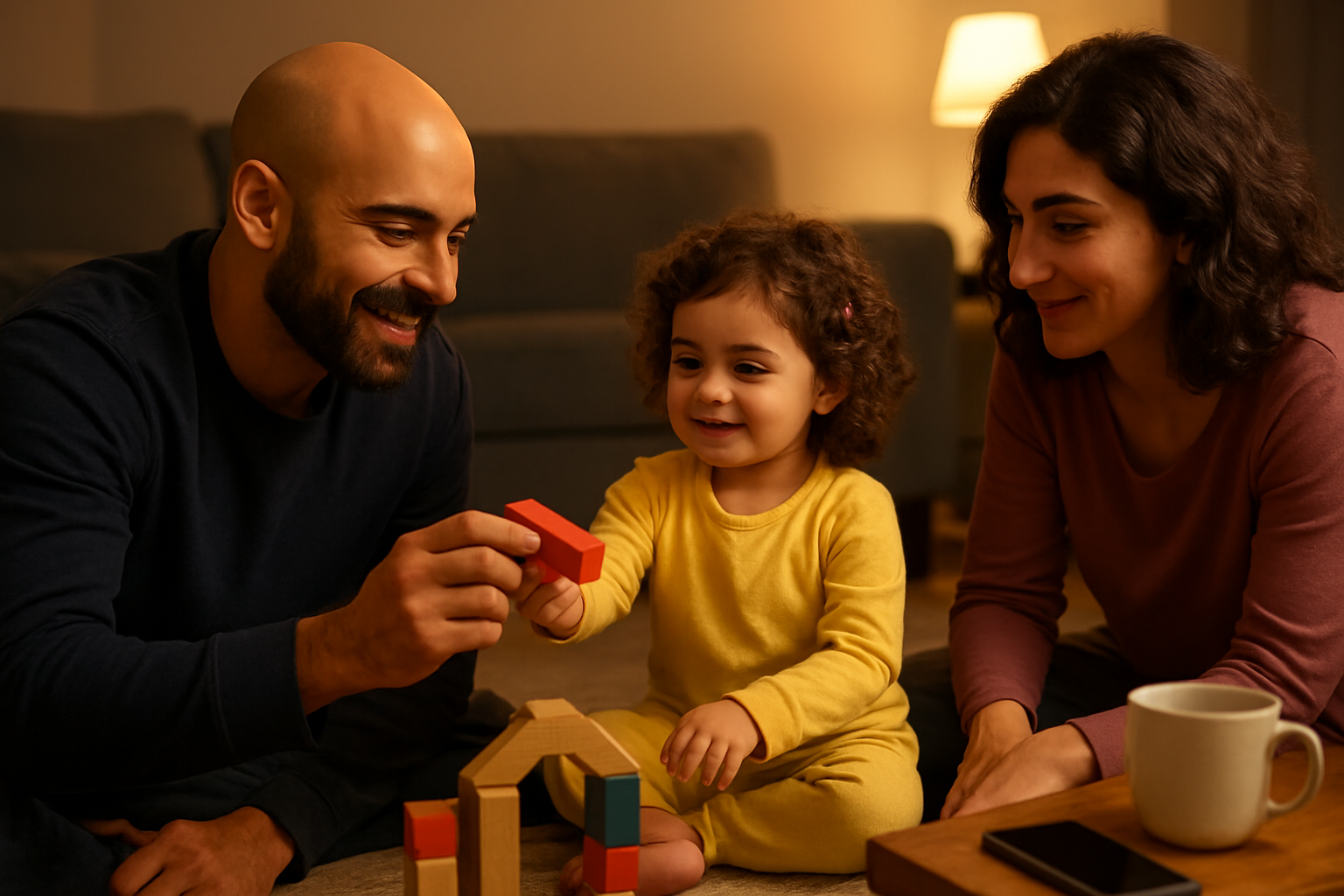
Hala wore yellow pajamas, and held a red block a little bigger than her palm. She lifted it as if she’d found the answer.
Ahmad had promised to join them for the game that evening. It wasn’t a grand promise, just the time the family had chosen to gather around something that asked no one to hurry.
On his way home, he’d kept turning over things that still needed his attention. They weren’t in the room now, but he felt them sitting with him at the edge of the rug.
He looked at the blocks and said:
“Give me a minute to sort out my thoughts, and then I’ll build with you.”
His wife looked up at him, her smile carrying more teasing than reproach.
“I know your minutes.”
Ahmad laughed, but his attention drifted back to what was occupying him. He sat at the edge of the rug instead of leaning into the game.
Hala waited. She didn’t hurry him or ask anything; she simply kept the red block raised, her face turned toward him.
“Where will you put it?” he asked.
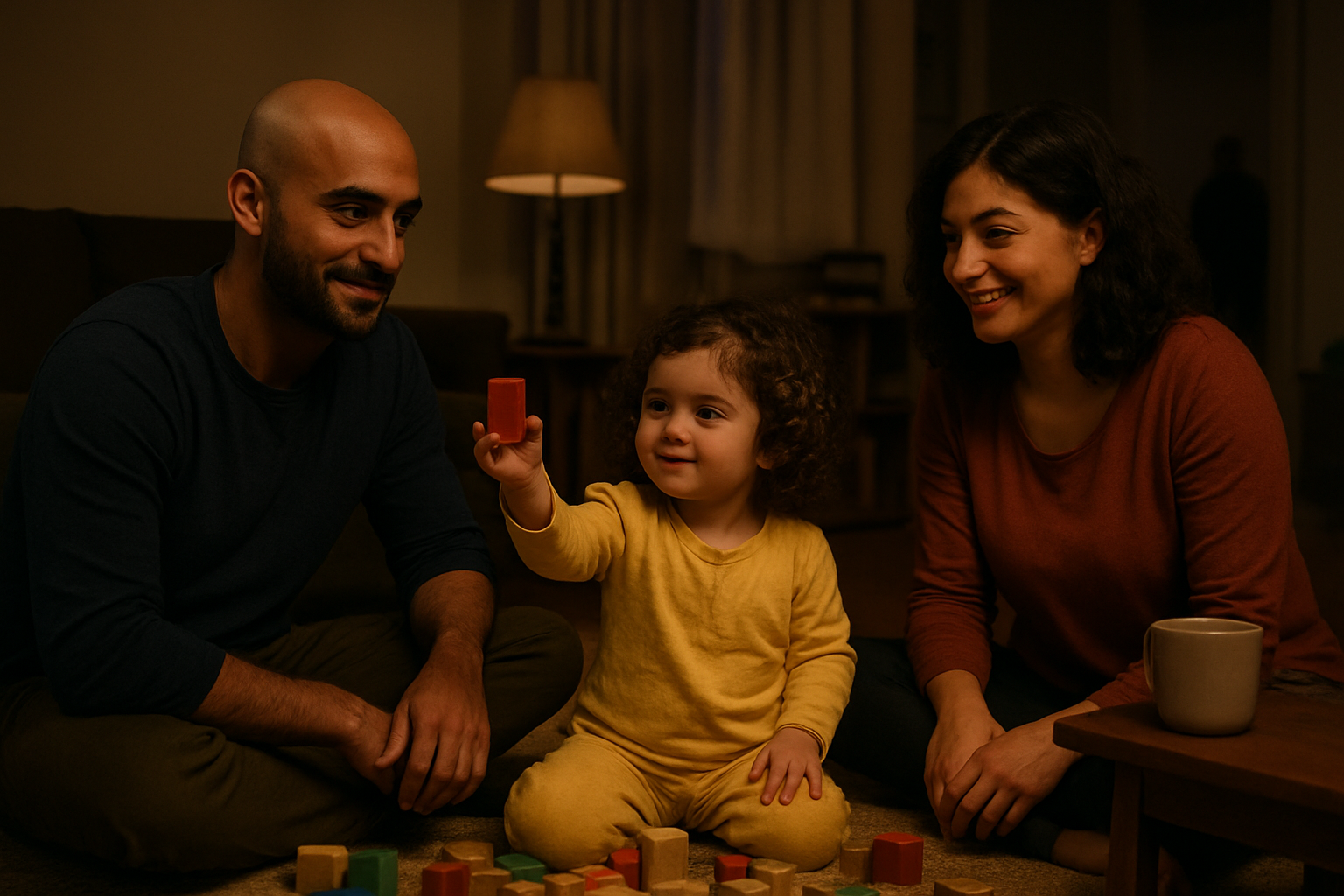
She pointed to a gap between two rows of blocks, then to her doll, sitting farther away by the sofa leg.
“It’s her bridge.”
Ahmad reached for a block. Building the bridge seemed simple: a base, another piece above it, then a space for the doll to cross.
They began together. Hala placed two pieces, Ahmad set a third between them, and his wife watched from where she sat.
When the bridge leaned, Ahmad steadied it with one finger. He eased his hand away, and it stayed upright. Hala gave a small, happy shout.
Then she wiggled another red block in her hand, as if the bridge still had work to do.
Ahmad said:
“Looks like we need a gate.”
His wife laughed. Hala turned to check that she’d heard the joke, then returned to the bridge with complete seriousness.
The bridge had to hold a doll, then a small block that Hala decided was her bag. Between the two attempts, Ahmad’s mind still wandered to other things.
His phone shifted once on the table. He didn’t reach for it, but caught the movement from the corner of his eye.
He hesitated. He could leave the game for a few more minutes, check what was waiting, then come back. He told himself that, as if saying it made the return certain.
He leaned toward the table, then stopped short of reaching it. Hala wasn’t looking at the phone. She was watching the block in his hand.
He said:
“Just one moment.”
Hala didn’t answer. She placed the doll by the gap and held one end of the bridge steady with her small palm.
Ahmad looked at her hand, then at the phone. In that moment, he understood: the game wasn’t waiting for an answer or a solution. It was waiting for his hand.
He turned the phone face down and moved it away from the edge of the table. Then he knelt until he was level with Hala, the red block still between his fingers.
He wore a dark blue home shirt. He looked up at Hala with a genuine smile, while his wife leaned nearer, her face warm and calm.
Ahmad said:
“This time, I’m with you.”
Hala handed him the red block, as though that was the only answer she’d been waiting for.
He fitted it onto the bridge. The structure tilted, so they steadied it together: Ahmad’s hand on one side, Hala’s fingers on the other.
One piece shifted, then settled. The bridge didn’t collapse this time. The doll crossed slowly, carrying the little bag Hala had made from a block.
Hala raised both hands, then turned to her father.
“We made it!”
Ahmad laughed with her and heard his wife laugh beside him. The bridge leaned a little, but it stayed up as long as they didn’t move away.
His wife said:
“I think the doll is lucky. She has two engineers.”
He looked at Hala, then at the bridge.
“Three. The doll knows where she’s going.”
His wife didn’t correct him. She simply smiled and nudged the blocks that had rolled near her foot closer.
Before long, the bridge had an entrance, a path, and a place where the doll could wait her turn. Hala added something, then came back to inspect what they’d built.
Whenever the bridge leaned, Ahmad moved closer instead of reaching from afar. He stopped counting the minutes and looking for the moment his turn would end.
Sometimes a block fell, and they put it back together. Sometimes Hala disagreed with Ahmad’s arrangement and changed it with such seriousness that he pretended to ask the expert for a review.
When the game ended, the bridge wasn’t perfect or straight. But it joined two sides, and the doll had crossed without anyone falling.
Hala lifted the doll from the rug and set it in her lap. She looked satisfied, as if she’d finished one little story just before another began.
As she gathered the blocks scattered around them, his wife said:
“There’s still a story before bed.”
Ahmad glanced at the clock, then at Hala. He didn’t look like he was searching for a minute to steal from something else.
He said:
“I’ll pick a short story, and we’ll finish the bridge tomorrow.”
His wife nodded, as if leaving the structure unfinished for once no longer seemed strange.
In Hala’s room, Ahmad sat by the bed and opened her storybook. Her shoulder rested against his arm, and her eyes stayed open as he began to read softly.
At the story’s first turn, Hala asked a little question, then waited. Ahmad answered without rushing and left space between the sentences.
Her eyelids grew heavy. Ahmad’s voice softened to a whisper, while her fingers stayed curled around his sleeve.
He closed the book quietly when she fell asleep. He didn’t get up at once; he stayed for a moment, looking at her resting face, his hand close to her small one.
In the living room, the bridge remained on the rug, leaning a little, with a red block in its middle. Ahmad left it there.
His wife passed nearby. He looked at her and smiled. Neither of them needed to explain what had changed that evening.
Before turning off the light, Ahmad glanced at the half-open door. Beyond it, the house was quiet, and the bridge was waiting for tomorrow.
Not everything in his mind was finished. But this time, he knew where to leave it, at least until morning.