

Inspired by a true story. Some characters, situations, dialogue, and chronology have been reimagined or combined for narrative purposes.
Ahmad stood at the hall doorway and found that the reading corner’s only chair looked like a guest for whom someone had forgotten to leave a way in.
He had come to a quiet indoor space used for neighborhood gatherings to prepare a modest corner for one visitor to try before leaving.
There was no opening ceremony and no waiting audience. He had arranged a short session in which the visitor would read something, then tell him how the space felt.
Even so, Ahmad had returned to the door several times, wanting the table, books, and chair to look orderly at first glance.
Daylight came through a side window. A soft air-conditioning hum and the smell of recently shifted table fabric lingered in the hall.
He wore a gray cotton shirt and dark trousers, with his sleeves rolled up after one had caught the edge of the cloth twice.
He set two closed books on the table and placed the chair directly facing them. From the doorway, its seat almost disappeared behind its tall back.
He tilted his head right, making the books clearer. He tilted left and saw an empty box he had forgotten beside a table leg.
The box was not part of the corner. He had brought the cloth in it, then left it there because that side of the table looked less bare with it.
Ahmad bent down and aligned its edge with the table. He straightened, then stepped back twice to look at the result again.
“Now even the box has a reserved place,” Ahmad said to himself. He smiled, but did not move it.
He wanted to invite someone to read, yet his hands remained occupied with what the arriving visitor would see before sitting down.
He raised the books slightly on a low wooden support, then pulled the cloth over its uneven edge. Another corner appeared on the opposite side.
He walked around the table to hide the new corner, and his shoe caught the box. Nothing fell, but the cloth slid back to its first position.
Ahmad held the cloth with his palm and gave a short laugh. He was guarding a piece of fabric in a hall that had not yet admitted a reader.
At last he left it and approached the chair. He wanted to know whether someone sitting there could reach a book without moving much.
He gripped the chair back and pulled, but its rear leg stopped against the box. He had to lift it slightly to set it behind his chosen position.
“All I need now is to welcome the man while carrying his seat,” Ahmad said. He lowered the chair gently and studied the narrow gap.
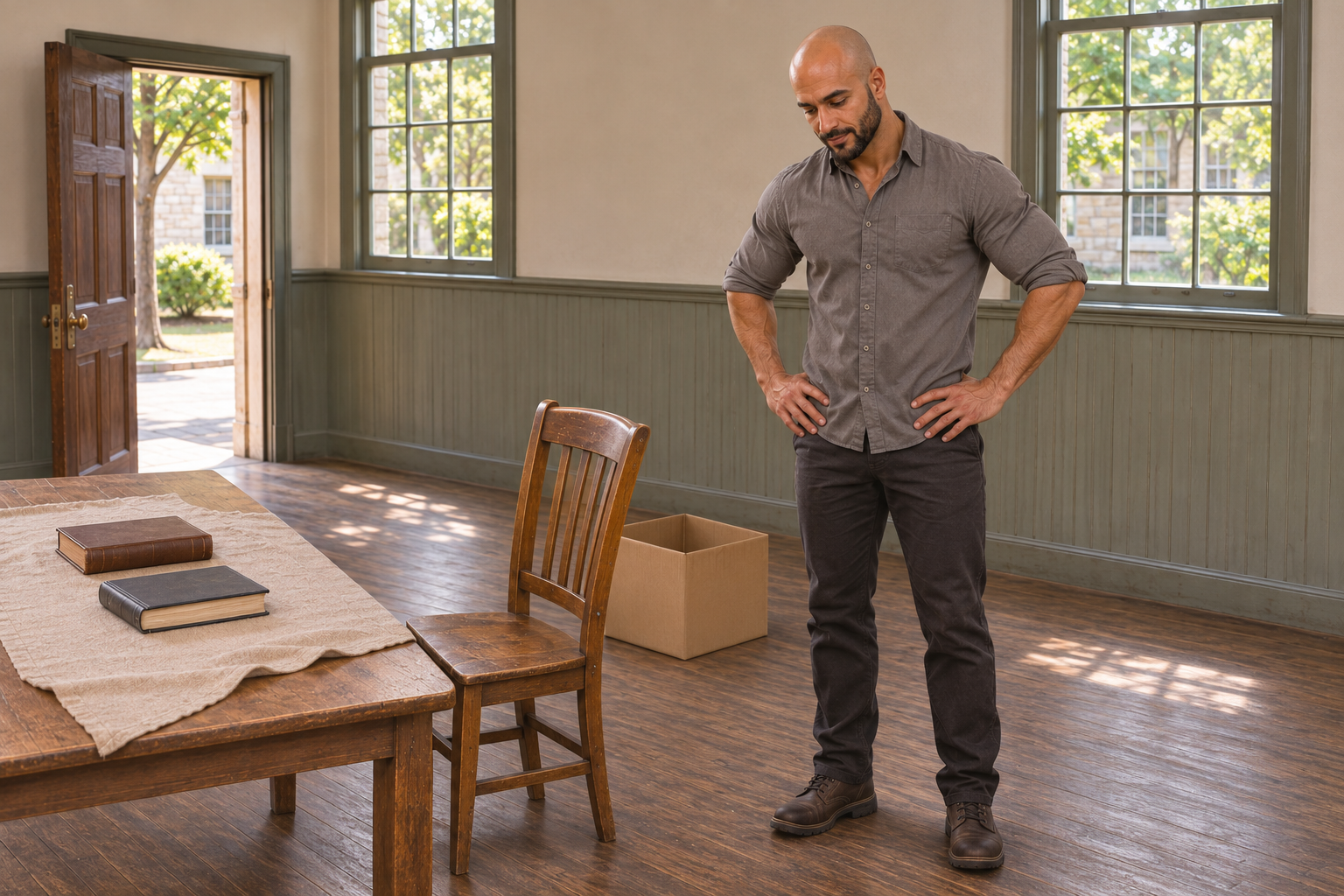
He passed sideways between the chair and table, then tried to turn and sit. His thigh touched the table edge, and he steadied a book before it could slide.
The contact did not hurt, but he heard himself quietly apologizing to the table, then laughed more at his apology than at the mishap.
At last he sat, with almost no room between his knees and the cloth. He could reach the book, but could not move the chair back a little.
From his seat, he could see only an edge of the doorway. The chair back he had admired from a distance now formed a barrier behind his shoulder.
He opened the book in the middle. Needing room for his arms, he shifted sideways and found himself reading with his body twisted and his eyes facing forward.
He closed the book and set it down. Nothing on the page prevented reading; the trouble lay in the position from which he insisted it should be read.
Ahmad rose slowly, pulling the chair with him this time. He left the table in place and stood beside it rather than returning to the doorway.
He turned the seat slightly toward the entrance, then paused. The corner opened up, but the box remained in the path as though objecting to the change.
He carried the empty box to the wall, outside the space between the doorway and chair. Returning, he found his hand lifting the chair unnecessarily.
He lowered it to the floor and slid it gently. This time it moved without striking anything, and Ahmad watched its legs for a moment.
“Excellent. The chair learned to walk before its owner,” Ahmad said. He tried again, sitting down from the side he had left open.
His feet settled beneath the seat, and he could move forward and back. He reached for the book, then returned it without bracing the table.
The cloth remained crooked, exposing the uneven support beneath it. He reached toward it, then stopped when he heard movement at the doorway.
The visitor he had arranged to meet entered, an adult man who had not seen the corner before. He greeted Ahmad, then stood near the entrance looking at the books.
Ahmad returned the greeting and indicated the chair. “Please. I was testing whether someone could sit down without prior training.”
The visitor smiled. “I came to read, not test my fitness.” He stayed near the doorway until Ahmad stepped out of the way.
Ahmad gestured toward the side he had opened up. He did not pull out the chair for the man, wanting him to choose his own distance.
The visitor approached, gripped the chair back, and moved it slightly beside the table. Ahmad watched and almost returned it to the angle he had chosen.
Before reaching out, Ahmad asked, “Is that more comfortable?” The visitor nodded. “I like to keep my elbow a little away from the table edge.”
The books and support had not changed, but the chair no longer matched Ahmad’s view from the doorway. He let his hand drop to his side.
The visitor sat and stretched his legs beneath the chair. He opened a book, then looked up before beginning, as if remembering a small detail.
“If I get up, can I leave the book open here?” the visitor asked, indicating an empty space beside the support rather than the center of the display.
“Of course,” Ahmad replied, moving the second book slightly to make room. He had to resist the urge to make the gaps between them equal.
The visitor opened his book and began reading. Ahmad stood beside the table, hearing a page turn and then the stillness of one hand resting over the other.
Ahmad noticed the edge the cloth had failed to hide. It seemed more conspicuous now precisely because the man had not looked at it at all.
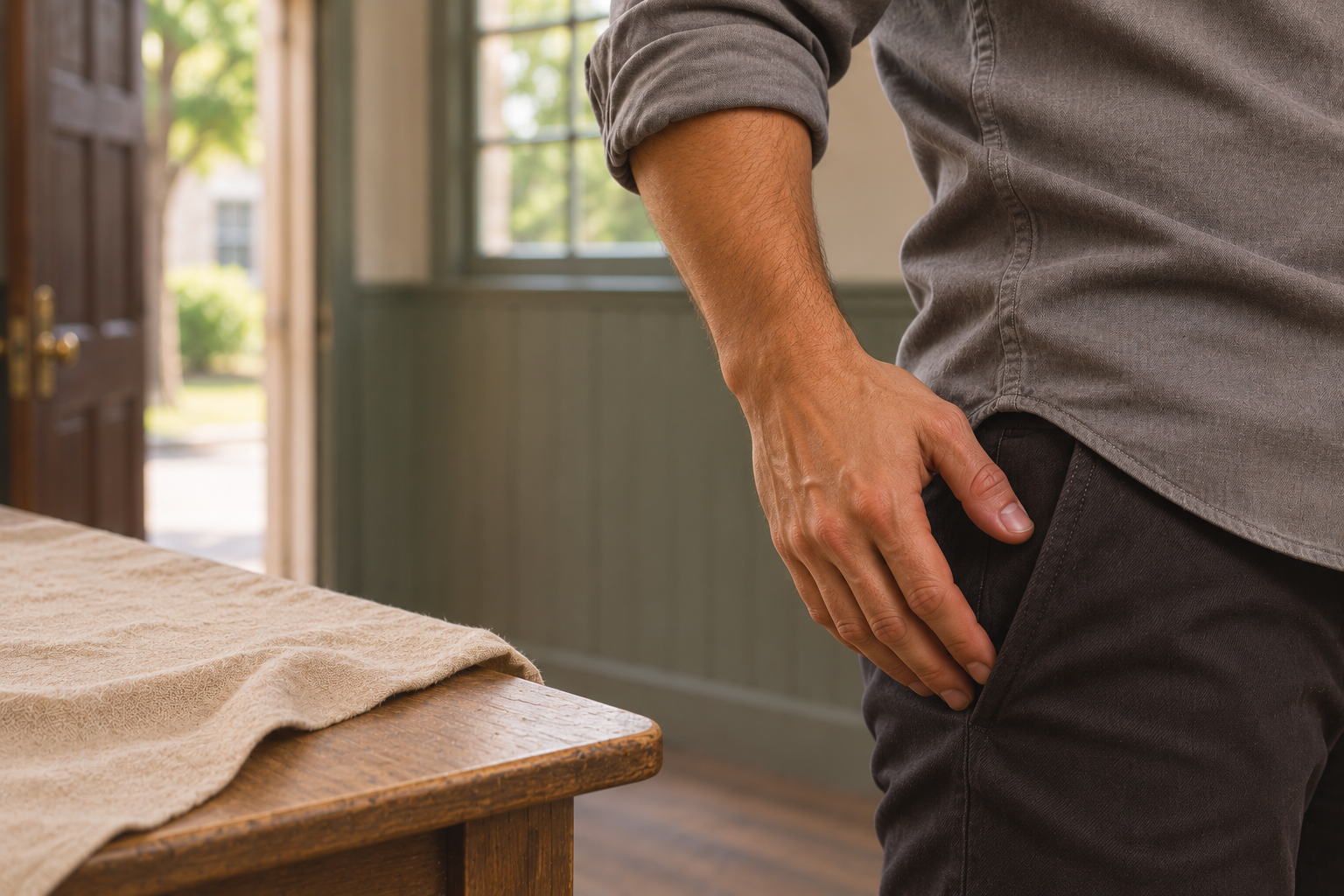
He reached for the cloth again, but would have had to lift the open book to pull it underneath. He returned his hand to his pocket.
After reading a little, the visitor looked up. “Do you have another chair? Not for me. For you, instead of standing like that.”
Ahmad laughed. “Apparently I prepared the corner and left myself out.” He fetched an ordinary chair from the side of the hall and kept it clear of the open path.
Ahmad sat without finding a reason to begin an explanation. The man had a book before him; Ahmad faced the cover of another he had not opened.
Ahmad picked up the second book and found that the cloth no longer reached his elbow. He left it alone and read the first two lines silently.
The visitor shifted a foot and caught the hanging cloth rather than the box. He lifted the fabric off his shoe and continued reading.
Ahmad noticed, stood, and shortened the hanging edge with one fold. “This is the last thing I’ll move while you read, I hope,” he told the visitor.
The visitor smiled. “Take your time, just don’t move my page.” Ahmad returned to his chair laughing, leaving the support visible at the edge.
Several quiet minutes passed without Ahmad proposing another adjustment. His wish to arrange things remained, but stayed in his fingers rather than reaching the table.
When the visitor closed the book, he kept a finger between its pages. He told Ahmad he would stand for a little while and asked whether he could return to the same seat.
“The seat is yours. Only the box has been permanently relocated,” Ahmad answered, pointing at the wall. The visitor laughed when he saw the empty box leaning there.
The man rose and left the book open in the space he had chosen. Nothing fell, and Ahmad did not need to hold the cloth from the other side.
Ahmad remained seated for a moment, looking at the hand’s impression on the page. He could close the book to restore the corner’s appearance, but did not touch it.
The visitor returned from the side of the hall. Ahmad stood to make room, then noticed that the path could accommodate both of them without the gesture.
“I’ve got used to being the doorway myself,” Ahmad said as he sat down. “Then it’s a good thing you sat,” the visitor replied with a smile.
The man reached for the chair back and pulled it to his preferred distance without asking where it should go. The book remained open before him.
Window light fell again on the exposed support edge. The shadow of the visitor’s hand crossed it as he reached for the book. This time the cloth stayed still.
Ahmad lowered his eyes to his own page and heard a single page turn from the other side. The chair had settled, and the man was reading.